Federal Battery Rebate Update: Lock In Higher Incentives Before May 2026

If you’ve been thinking about installing a solar battery, this is important.


The Australian Government has expanded the Cheaper Home Batteries Program from $2.3 billion to $7.2 billion — which is fantastic news for Australian households.


However…
From 1 May 2026, the way the rebate works will change — and rebate amounts will begin reducing more frequently.


That means homeowners who install sooner will receive a higher incentive than those who wait.

What’s Changing From 1 May 2026?

• Rebates Will Reduce Every 6 Months
Instead of dropping once per year, the rebate value will now decrease twice a year.
The longer you wait, the lower the incentive.

• New Tiered Battery Incentive Structure
The rebate will no longer be a flat amount per kWh. It will now scale depending on battery size:
• 0–14 kWh → Full incentive (maximum rebate)
• 14–28 kWh → 60% of full rebate
• 28–50 kWh → 15% of full rebate
• Above 50 kWh → Only first 50 kWh qualifies
This is designed to support properly sized residential systems while discouraging oversized installs.
For most standard homes, the rebate still equates to around 30% support — but locking it in early is key.

Why This Matters for NSW Homeowners

If you’re in Lake Macquarie, Newcastle, Central Coast or the Hunter, you’re likely already feeling:
• Rising electricity prices
• Lower feed-in tariffs
• Summer storm blackouts
• Increased evening usage
A properly sized solar battery system allows you to:
✔ Store more of your own solar
✔ Use power at night instead of buying from the grid
✔ Protect essential circuits during outages
✔ Prepare for EV charging
And with current incentive levels, 2026 is still one of the strongest years to install.

Installation Dates Available – From March

Here’s the part most installers won’t tell you:
Demand is already increasing ahead of the May 2026 changes.
Some companies are booking months out.


At DNR Air Conditioning & Solar, we currently have installation slots available, and we can install from March onward.


If you’re even considering a battery this year, it makes sense to secure your installation date now and lock in the higher rebate.

Let’s Get You Sorted

We’ll:

  • Correctly size your battery (so you maximise rebate value)
  • Handle all federal rebate paperwork
  • Ensure compliance with the new structure
  • Deliver a clean, professional installation

📞 Call us on (02) 4970 5078
📩 Or contact us to secure your install date.

Don’t wait for the rebate to reduce.

Let’s get it installed and locked in.

Is 2026 the Year to Go Solar in NSW? Why Thousands of Aussies Are Switching

Is 2026 the Year to Go Solar in NSW?

If rising electricity prices in 2026 have you looking for solutions, you’re not alone. Across NSW, households are turning to solar and battery systems to cut bills, protect against blackouts, and future-proof their homes. With the federal Cheaper Home Batteries Program delivering thousands off eligible home batteries, plus ongoing STC solar rebates, 2026 is a standout year to invest.

Why prices make solar smarter in 2026

The Australian Energy Regulator’s Default Market Offer 2025–26 lifted benchmark prices in NSW, so every kWh you avoid buying from the grid matters. A hybrid inverter and LFP home battery shift your solar to evenings and peaks where tariffs bite. New to batteries? Start with our explainer: The Future of Home Battery Storage

2026 rebates: solar STCs + federal battery discount (+ NSW VPP)

Backup power during outages (summer storms)
With the right design (islanding + essential circuits), a solar battery system keeps lights, Wi‑Fi and fridge running during a blackout something standard solar can’t do alone. See our Solar Battery Systems page

AC vs DC-coupled batteries (which is best for you?)

  • AC-coupled (add-on): great for adding a battery to existing solar
  • DC-coupled (hybrid): ideal for new solar + battery packages ; often higher round‑trip efficiency.

Smart-home ready (EVs, heat pumps & dynamic tariffs)
Pair solar with high‑efficiency air conditioning and heat‑pump hot water for bigger savings. Ask about VPP‑ready settings during your design consult.

What size is right in 2026?

  • 15–20 kWh battery: bill savings + backup for essentials overnight
  • 20–25 kWh: families with higher evening use / EV top‑ups
  • 30 kWh+: whole‑home ambitions or larger properties

FAQs
Is there a battery rebate in 2026? Yes—the federal program is live. See our Federal Battery Rebate page ().

Do solar STCs still apply in 2026? Yes—ask us during your quote and we’ll show the STC line‑item.

What’s the payback like? We model it for your tariff and usage; browse our Project Gallery for local installs and outcomes.

More questions? Check our FAQ or contact our team.

Ready to plan your 2026 system?
We design and install solar + batteries for Lake Macquarie, Newcastle, the Hunter and the Central Coast—with clean installs, aftercare and options like finance

Call (02) 4970 5078 or contact us for a free 2026 solar & battery quote.
AC vs DC Coupling for Solar Batteries: Which Is Best for Your Home?

If you’re adding a battery to your solar—or building a brand-new solar + storage system—you’ll quickly meet two terms: AC-coupled and DC-coupled. Both store your daytime solar for night use, but the way they connect affects efficiency, retrofit ease, backup behaviour, and overall cost.


Below, we break it down in plain English and show where the ESY Sunhome HM6 fits.

Quick definitions
DC-coupled (hybrid)
Your panels and battery sit on the DC side and typically share a hybrid inverter. Solar charges the battery before power is converted to AC for your home. Fewer conversions = higher charging efficiency and the ability to capture “clipped” solar on bright days. The ESY Sunhome HM6 is an all-in-one hybrid system (integrated 6 kW single-phase inverter + modular LFP battery), which makes it a natural fit for DC-coupled new installs.
AC-coupled (add-on)
Your battery has its own battery inverter and connects to the AC wiring of the home (separate from the solar inverter). That’s usually easier for retrofits because you don’t touch a working PV inverter—you just add a battery inverter that charges/export via AC. (Some vendors note ESY can be integrated in AC-coupled scenarios; check your site specifics and approved configurations.)


The differences that matter
1) Efficiency & captured solar
• DC-coupled: Fewer AC↔DC conversions, so more of your PV makes it into the battery; can also store solar that would be “clipped” at the PV inverter limit.
• AC-coupled: Solar is converted to AC, then back to DC to charge the battery—slightly lower round-trip efficiency over a year.
2) Retrofit vs new build
• Already have solar you like? AC-coupled is usually faster, simpler, and less disruptive—keep your existing PV inverter and add a battery inverter.
• Building new (or replacing an old inverter)? DC-coupled hybrid (like ESY HM6) is often the cleanest and most efficient path because PV and battery share one integrated system.
3) Backup power behaviour
Both can do backup if designed for it, but details vary by model and wiring. The ESY HM6 is designed as a single-phase hybrid with backup capability in a compact, IP-rated enclosure—great when you want battery + backup in one unit. Ask your installer to design a critical-loads sub-board.
4) Flexibility & components
• AC-coupled keeps solar and battery modular—handy if you want to keep your current PV inverter and choose a separate battery brand/inverter.
• DC-coupled hybrids offer tight integration (one box manages PV, battery, backup, monitoring). The ESY HM6 integrates a 6 kW hybrid inverter and modular 5.12 kWh LFP blocks up to ~30.72 kWh, with monitoring and AI-optimisation.
5) Safety & durability
ESY Sunhome uses Lithium Iron Phosphate (LFP)—a stable chemistry with long cycle life—plus layered protection/BMS and weather-resistant enclosure (IP66 stated by multiple AU sellers). That’s ideal for Australian homes.


Pros & cons at a glance
AC-coupled (best for retrofits)
Pros: Easy add-on to existing systems; brand-agnostic; minimal downtime.
Cons: Extra conversions (slightly lower efficiency); two inverters to coordinate.
DC-coupled (best for new installs / replacing inverter)
Pros: Higher PV-to-battery efficiency; captures clipped energy; one integrated hybrid.
Cons: Requires a compatible hybrid inverter; retrofits may mean replacing an inverter.


Where the ESY Sunhome HM6 shines
• All-in-one hybrid: 6 kW single-phase hybrid inverter integrated with modular LFP storage (5.12 kWh blocks) scalable to ~30.72 kWh—a neat DC-coupled solution for new installs.
• Approved for AU use: Listed/reviewed locally with strong safety credentials and monitoring.
• Practical backup + monitoring: Compact, IP-rated enclosure with 24/7 online monitoring and AI-based control noted by AU distributors.
Retrofit note: If you already have PV, you can integrate ESY Sunhome when moving to a hybrid architecture (i.e., replacing the existing inverter with HM6), or explore AC-side integration where supported. Your installer should confirm approved coupling modes for your exact inverter/battery firmware and compliance.


What should a homeowner choose?
Use this rule of thumb:
• Keeping your current solar inverter? → AC-coupled add-on is usually simpler.
• New solar + battery (or inverter due for replacement)? → DC-coupled hybrid like ESY Sunhome HM6 gives you better integration and a small efficiency edge.
Either way, a well-designed system will cut your evening bills, improve blackout resilience, and set you up for VPP participation later.


Specs snapshot: ESY Sunhome HM6 (Australia)
• Inverter: 6 kW single-phase hybrid (integrated)
• Battery: Modular LFP, 5.12 kWh per module, up to ~30.72 kWh
• Enclosure: Compact, IP-rated (multiple AU sources state IP66)
• Monitoring: App/online 24/7 monitoring, AI-optimised control (vendor-noted)
• Warranty: Typically 10 years (check your specific kit/retailer)


Next steps (DNR can help)
• Have existing solar? We’ll compare AC-coupled add-on vs moving to HM6 hybrid, including NSW/Federal incentives and VPP readiness.
• Building new? We’ll size an ESY Sunhome HM6 package (5.12–30.72 kWh) to your usage and tariff, with backup circuits designed for your essential loads.


Call 02 4970 5078 or visit https://dnraircon.com/contact/ for one of our team to get back to you.

The Future of Home Battery Storage

Are you ready to unlock serious energy independence and maximize your solar savings in 2025?

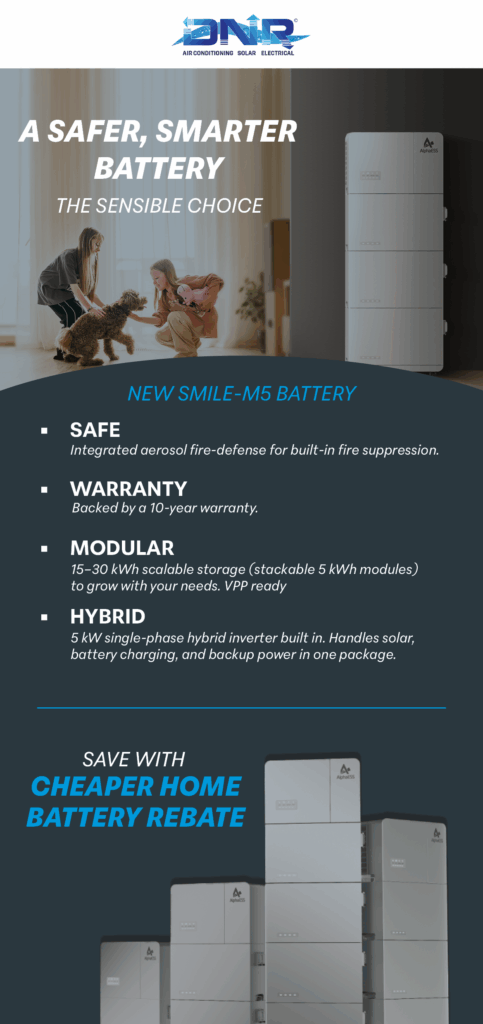
DNR Air Conditioning and Electrical, we’re excited to offer one of the smartest and most powerful residential batteries on the market — the AlphaESS SMILE-M5.
This cutting-edge 15-30kWh lithium battery is perfect for large family homes or small businesses across the Central Coast, Lake Macquarie and Newcastle regions looking to reduce energy bills, beat peak tariffs,
and future-proof their power.

Why Choose the AlphaESS SMILE-M5?

• Massive up to 30kWh Storage Capacity – Ideal for high-usage households or backup during outages.
• Seamless Solar Integration – Works perfectly with new or existing solar PV systems.
• Modular & Scalable – Stackable design allows you to expand capacity.
• Smart Monitoring App – Track performance, consumption and savings in real-time.
• VPP-Ready & Incentive Eligible – Qualifies under NSW and Federal Battery Rebates.
Built for Safety, Efficiency, and the Australian Climate
Manufactured with Lithium Iron Phosphate (LFP) chemistry for safer, longer life performance.
Includes:
– Advanced Battery Management System (BMS)
– High discharge rate for full backup use
– Temperature-resilient for NSW conditions
Perfect for Households Like Yours
If your family:
• Uses more power in the evenings
• Wants to lower power bills without sacrificing comfort
• Already has rooftop solar but no battery
• Has experienced power outages and wants backup power…

Then the SMILE-M5 is your ideal next step.

The Future of Home Battery Storage 1

Big Changes Coming to Battery Rebates in NSW – Here’s What You Need to Know

Big Changes Coming to Battery Rebates in NSW – Here's What You Need to Know 2

! If you’ve been thinking about adding a solar battery to your home, this is something you’ll want to hear.
🔋 The NSW Battery Rebate Is Wrapping Up
The NSW Government has just announced that the current battery rebate will officially end on 30 June 2025. They made the news sound like a win—talking about “doubling battery incentives”—but what it really means is the state rebate is being replaced by new federal incentives and Virtual Power Plant (VPP) payments.

Big Changes Coming to Battery Rebates in NSW – Here's What You Need to Know 3

⚠️ Here’s the Gist:
• You can’t combine the NSW rebate with the new federal rebate starting 1 July 2025.
• If you’re considering a battery, it might make more sense to wait just a little longer and grab the bigger federal offer—but contact us now to book your battery install, because we’re already booking up fast for July and beyond.
• The federal rebate (under the Cheaper Home Batteries Program) offers $375 per usable kilowatt-hour (kWh) of battery storage, up to a maximum of $18,500 per property. For example:
o A 10kWh battery would attract a rebate of $3,750
o A 13.5kWh battery could receive $5,062.50
o A 17kWh battery would be eligible for $6,375
• NSW tried to make the state rebate “stackable” with the federal one, but that unfortunately didn’t go through.
💡 The Good News? Bigger VPP Incentives Are on the Way!
Starting 1 July 2025, you can get a one-off VPP payment of up to $1,500 for connecting your battery to an eligible VPP program. Here’s a quick snapshot:
• Around $550 for a 10kWh battery
• Up to $1,500 for a 27kWh battery
• Applies to batteries between 2kWh and 28kWh
• You’ll need to sign up through an Accredited Certificate Provider (ACP)
• And yes—you can claim this alongside the federal rebate!
So if you’re willing to let your battery help support the grid during peak times, you’ll be rewarded for it.
🏡 What Should You Do Next?
If you’re in Lake Macquarie or surrounding areas, here’s our advice:
1. Contact us now – We’re booking installs fast and want to make sure you’re ready to go for July 1.
2. Let’s chat and confirm your eligibility for the new incentives.
3. We’ll also walk you through how to join a VPP and get the maximum savings.
___________________
At DNR Air Conditioning & Solar, we’ve proudly been serving the community for over 16 years. We’re locals just like you, and we’re here to make solar simple, affordable, and future-ready.
___________________

Slash Your Power Bills with NSW & Federal Solar Battery Rebates – Here’s How

Thinking About a Home Battery? Here’s Why Now’s the Perfect Time

You know that feeling when your power bill lands in your inbox and you do a double take? Yeah, I’ve been there. A few years back, after one too many of those shocking bills, my partner and I finally bit the bullet and installed solar. It felt great—like we were doing something good for the planet and our wallet. But even then, we noticed something odd. Most of our solar power was getting sent back to the grid during the day… and we were still paying for electricity at night. That’s when we looked into adding a battery. And wow—game changer.

🔋 NSW Battery Rebates—Your Shortcut to Serious Savings
Since November 1, 2024, the NSW Government has been helping homeowners and small businesses get battery systems through the Peak Demand Reduction Scheme (PDRS).

– Up to $2,400 off upfront, depending on your battery size

– Bonus $250–$400 if you connect to a Virtual Power Plant (VPP)—you can even claim this twice, three years apart

I recently helped a lovely couple in Charlestown—Jim and Carol—who were nervous about the cost of installing a battery. With the rebate, they saved over $2,000 right away.

🌞 Why Add a Battery to Your Solar Setup?
Here’s what else it brings:

– Store your extra solar energy instead of sending it to the grid for peanuts

– Use that stored power at night, cutting your power bill by around $1,500 a year

– Join a VPP and earn extra by helping balance the grid during peak times

Learn more about our solar battery installation services

🧐 Am I Eligible for the NSW Battery Rebate?
– A working rooftop solar system

– An install from a PDRS-accredited supplier (like us!)

Not sure? Contact us for a free eligibility check.

🇦🇺 Federal Battery Rebate (Launching July 2025)
Starting July 1, 2025, the Federal Government will offer up to $18,500 in battery rebates through the Cheaper Home Batteries Program.

More info available at energy.gov.au

We’ve summarized the program on our site here: Cheaper Home Batteries Program

💡 Why Trust DNR Air Conditioning?
We’ve proudly served Lake Macquarie and surrounds for 16+ years. Our team delivers:

– Personalised consultations

– Rebate-compliant battery installations

– Full support for VPP setup

Learn more about DNR

⚡ Take the Next Step
Now’s the time to lock in these rebates and start saving on energy.

👉 Book your free consultation today

Federal Battery Rebate Update: Lock In Higher Incentives Before May 2026

If you’ve been thinking about installing a solar battery, this is important. The Australian Government has expanded the Cheaper Home Batteries Program from $2.3 billion to $7.2 billion — which is fantastic news for Australian households. However…From 1 May 2026, the way the rebate works will change — and rebate amounts will begin reducing more

Read More »

Is 2026 the Year to Go Solar in NSW? Why Thousands of Aussies Are Switching

Is 2026 the Year to Go Solar in NSW? If rising electricity prices in 2026 have you looking for solutions, you’re not alone. Across NSW, households are turning to solar and battery systems to cut bills, protect against blackouts, and future-proof their homes. With the federal Cheaper Home Batteries Program delivering thousands off eligible home

Read More »

Summer Storm Season is approaching

Summer Storms & Blackouts: How Solar + a Battery Keep Your Home Connected Storm season is here – don’t be left in the darkIf you live around Lake Macquarie, Newcastle, or the Central Coast, you know the drill: hot, humid afternoons… then the sky cracks open. A branch on the lines and boom, the power’s

Read More »

AC vs DC Coupling for Solar Batteries: Which Is Best for Your Home?

If you’re adding a battery to your solar—or building a brand-new solar + storage system—you’ll quickly meet two terms: AC-coupled and DC-coupled. Both store your daytime solar for night use, but the way they connect affects efficiency, retrofit ease, backup behaviour, and overall cost. Below, we break it down in plain English and show where

Read More »

The Future of Home Battery Storage

Are you ready to unlock serious energy independence and maximize your solar savings in 2025? DNR Air Conditioning and Electrical, we’re excited to offer one of the smartest and most powerful residential batteries on the market — the AlphaESS SMILE-M5.This cutting-edge 15-30kWh lithium battery is perfect for large family homes or small businesses across the

Read More »