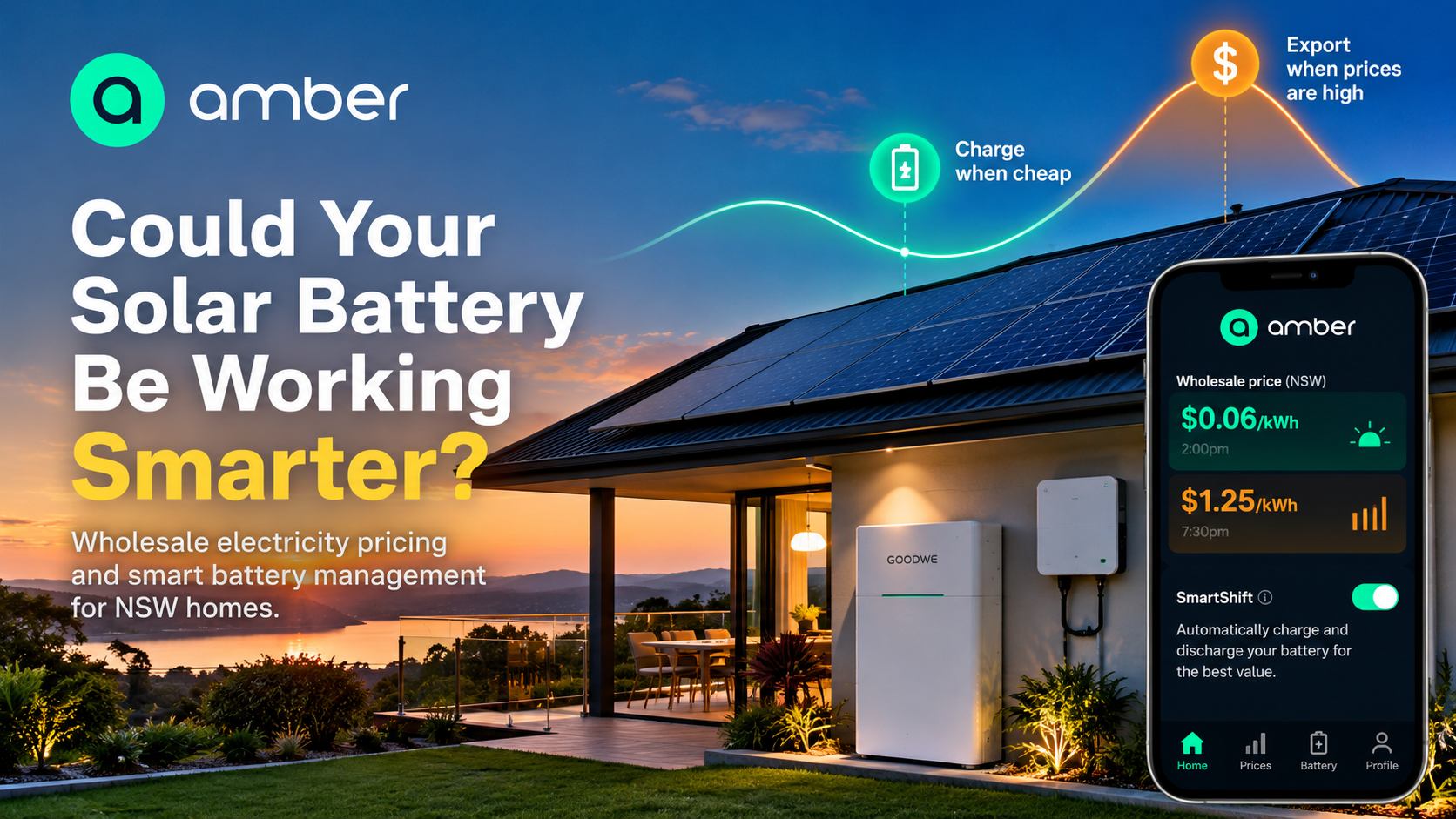
Discover how wholesale electricity pricing and smart battery management could help NSW homeowners get more value from their solar energy.
Are You Getting the Most From Your Solar and Battery?
With electricity tariffs and solar feed-in rates continuing to change, many homeowners are looking for smarter ways to manage their energy costs. Amber Electric NSW offers an alternative approach through wholesale electricity pricing and automated battery management using SmartShift.
Even with solar panels and battery storage, homeowners can still face daily supply charges and electricity bills. Understanding how and when you use, store and export electricity can make a significant difference.
While NSW default electricity prices have decreased for 2026–27, individual retail plans and household energy costs can vary considerably.
That’s where <underline>Amber Electric</underline> may offer another option.
What Is Amber Electric NSW and How Does It Work?
Unlike traditional electricity retailers offering fixed usage rates, Amber provides access to wholesale electricity prices, which fluctuate throughout the day.
When electricity is plentiful, wholesale prices can fall significantly. During periods of high demand, prices can rise sharply.
For households with compatible batteries, this creates opportunities to store electricity when prices are lower and potentially export stored energy when prices are higher.
Amber charges a monthly subscription fee in addition to applicable electricity and network charges.
Wholesale pricing carries risks, including price spikes and unpredictable export earnings, so it’s important to compare plans carefully.
How Does Amber SmartShift Work?
Amber’s SmartShift technology can automatically manage compatible solar batteries using forecasts of electricity prices, solar generation and household consumption.
Depending on your system and settings, SmartShift can:
-
Charge your battery when electricity is cheaper.
-
Store solar energy for use later.
-
Export electricity when wholesale prices are favourable.
-
Maintain a nominated battery reserve for household needs.
The aim is to make better use of your battery without requiring constant manual adjustments.
However, actual savings depend on your system, electricity usage and changing market conditions.
Good News for GoodWe ESA Battery Owners
Amber SmartShift now supports compatible GoodWe ESA Series battery systems, following an integration announced in October 2026.
This is particularly relevant to DNR customers, as we’ve been supplying and installing the GoodWe ESA range in recent months.
Eligible GoodWe ESA owners may now be able to take advantage of SmartShift’s automated charging and discharging features without replacing their existing battery hardware.
Amber also supports selected systems from other manufacturers, including Sungrow, Tesla, AlphaESS, Sigenergy and SolarEdge.
Not every battery or inverter model is compatible. Support depends on the specific model, firmware, connectivity and installation configuration.
Before switching retailers, check your equipment using Amber’s official tool:
CHECK YOUR BATTERY COMPATIBILITY
Could Amber Help Reduce Your Electricity Bills?
Amber’s NSW battery information includes historical modelling suggesting that some households with suitable batteries may achieve additional savings compared with selected conventional electricity plans.
For households considering Amber Electric NSW, the potential benefits depend on battery capacity, electricity consumption, wholesale prices and how effectively the system is managed.
However, these are illustrative comparisons—not guaranteed results.
Actual outcomes depend on battery capacity, household electricity consumption, network tariffs, wholesale market prices and how the system operates.
You can explore indicative results using the Amber Battery Calculator.
It’s also worth comparing your current electricity plan through the Australian Government’s Energy Made Easy website.
Common Questions About Amber Electric and SmartShift
1. Isn’t wholesale electricity pricing risky?
Wholesale electricity prices can rise sharply during periods of high demand. However, households with a suitably sized battery may be able to reduce their exposure by using stored electricity instead of purchasing expensive grid power.
Amber SmartShift can also take advantage of favourable export prices when conditions allow.
There is still financial risk, particularly if your battery is depleted or your household needs to import electricity during a price spike.
2. How is Amber different from a traditional Virtual Power Plant (VPP)?
Some traditional VPP programs offer fixed rewards or incentives in exchange for allowing a provider to manage battery operation.
Amber takes a different approach, giving customers access to variable wholesale export prices and automated battery management through SmartShift.
Customers can adjust their battery settings and reserve preferences, providing greater control over how their stored energy is used.
3. If my battery already saves me money, why would I need Amber?
A solar battery can reduce electricity bills by storing excess daytime solar energy for use later.
Amber may offer additional opportunities by allowing compatible batteries to charge when electricity is cheaper and export stored energy when wholesale prices are favourable.
Whether this provides additional financial benefits depends on your household’s electricity usage, battery capacity and market conditions.
4. Will using SmartShift wear out my battery faster?
Batteries are designed to charge and discharge regularly. However, additional cycling can contribute to battery wear over time.
Amber states that SmartShift operates within manufacturer integration requirements, but battery owners should still check their specific manufacturer’s warranty conditions and operating limits.
5. What if I need my battery power for my home?
Amber SmartShift allows customers to nominate a battery reserve to help retain stored electricity for household use.
The system considers expected solar generation, electricity consumption and wholesale prices when planning battery operation.
However, customers should understand their reserve settings and remember that actual battery availability can vary.
Before switching to Amber, check your battery’s compatibility and review whether wholesale electricity pricing suits your household.
CHECK YOUR BATTERY COMPATIBILITY
Don’t Have a Solar Battery Yet?
If you already have solar panels but no battery, adding storage could help you use more of your own solar electricity and reduce your reliance on the grid.
DNR can help you choose a suitable battery system, including the GoodWe ESA range, based on your energy consumption, existing solar installation and budget.
Whether you’re considering your first battery or upgrading an existing system, our team can help you understand the available options.
Talk to DNR About Your Solar and Battery Options
With over 17 years of local experience, DNR Air Conditioning & Electrical supplies and installs solar and battery systems throughout Lake Macquarie, Newcastle, the Central Coast and surrounding areas.
As a NETCC Approved Seller and SolarQuotes Approved Installer, we provide professional installation backed by local after-sales support.
Want to get more value from your existing solar system or explore adding battery storage?
CONTACT DNR FOR SOLAR & BATTERY ADVICE
Disclaimer: This article provides general information only. Amber’s electricity prices, fees, compatibility requirements and potential financial outcomes may change. Wholesale electricity pricing involves risks, and savings are not guaranteed. DNR provides solar and battery installation services; Amber manages its electricity retail plans, SmartShift settings and customer accounts.
Call (02) 4970 5078 or contact us for a free 2026 solar & battery quote.